


The Ripple Effect: From an Egyptian Alley to Global Fair Trade
How the FTF's 9 Core Principles Change Everything
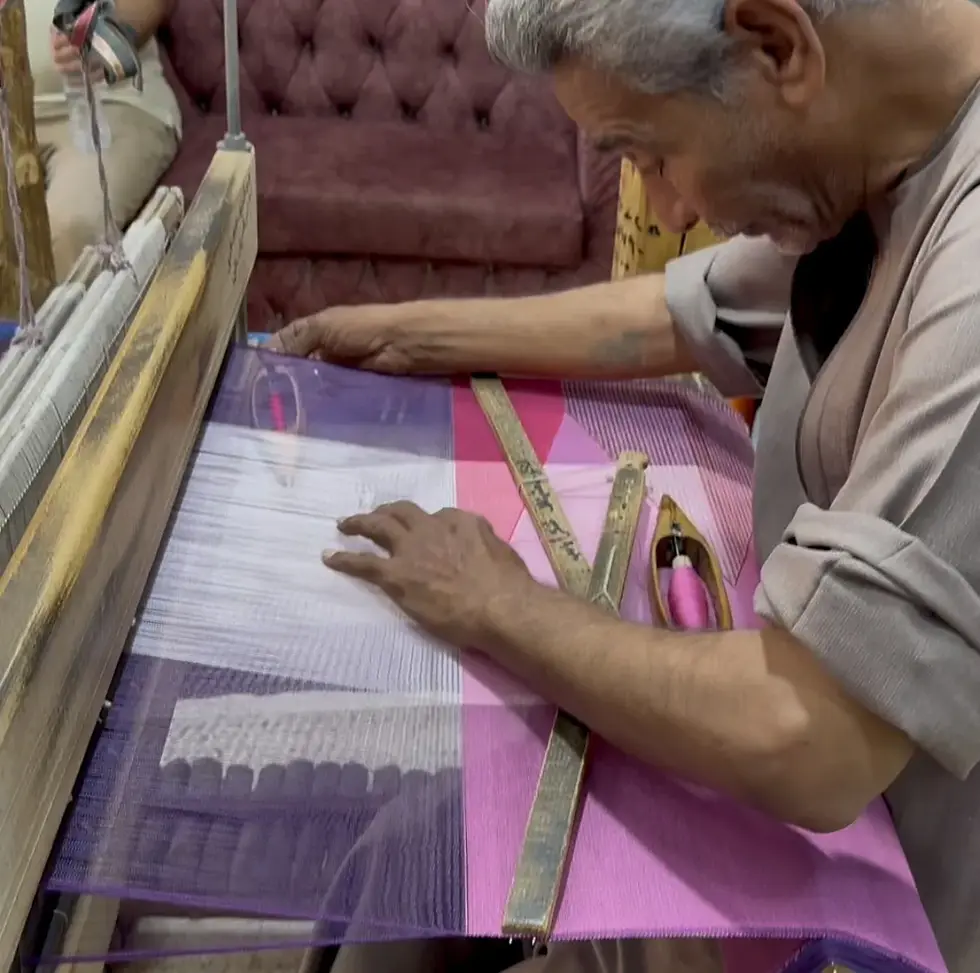
The unassuming shop is set back from the gauntlet aisle of noisy touristy trinket and t-shirt hawkers.
We’re in Egypt. Every tomb or ruin or pyramid site has tourist alleys at the exit points. Now into our second week of the tour we are unfazed by the brazen sales jousting. I think that’s why this quieter enclosure counterintuitively stands out.
What is it?
We step inside.
The chaos in the outer alleyway feels distant, muted. Along the walls hang a rainbow of woven scarves, tunics, shawls, bed linens. The hand-woven textiles are silky smooth to the touch. Their surfaces ripple like water when stirred. Entranced, I wander further in.
Located close to the back wall, sitting partially obscured by a large loom, I discover a seated man rhythmically pulling and placing strands of deep rose and pink threads into an intricate design. I stand for a moment watching. The tip of a triangle begins to emerge. A pyramid? We are in Egypt after all.
The moment was intimate, a silent witness to careful skill and the dignity of work. Yes,—I buy a scarf. Blues, purples, some reds. Knowing it will be a tangible connection to the memory of the trip.
Yet, this simple act of commerce raised a profound question that many travelers ask: Does the artisan I met actually make money from their handiwork when their goods are sold elsewhere?
The unsettling answer is often “no.” Instead, a gauntlet of middlemen minimize the artisan’s portion to a minuscule, often exploitative, amount.
How the Fair Trade Movement Kicked Off
Enter the core principles of the global Fair Trade movement, which is fundamentally reshaping commerce, community, and dignity around the world. The initial match strike for the idea came from curious and caring tourists like you and me. For it was their desire to connect consumers directly with producers and ensure fair compensation that sparked its inception.
Prior to our trip to Egypt, I’d been reintroduced to this business model. The concept is perfectly embodied by Zee Bee Market in St. Louis, an American immigrant story with global impact. I got to know Zee Bee last August when I was searching for gift items to offer in my current holiday sweepstakes.
Owner Julio Zegarra-Ballon came to the U.S. from Peru and leveraged his retail experience and entrepreneurial spirit to address inequities he saw in the sale of artisan items.
His journey began by volunteering with an organization connecting North American consumers with artisans in extreme poverty. This passion soon merged into his own business, Zee Bee Market, rooted in the belief that business decisions must prioritize people and planet over profit.
As Julio states, his goal is to give customers the opportunity to “demand quality in the products they buy just as much as demanding quality in the lives of the people who make them.” Zee Bee Market, now a proud member of the Fair Trade Federation (FTF), stands as a mission-driven business connecting the community with unique, handcrafted, and sustainably produced goods.
For Julio, his handmade items “stand for equality. They stand for dignity. They stand for beauty.”
The Fair Trade Philosophy: Not Charity, But Partnership
When people think of Fair Trade, they usually think of fair wages. Of course, that’s a crucial component. However, the movement is about much more. It’s an approach to development and business based on dialogue, transparency, and respect—an effort to create greater equity in the international trading system.
It is not about charity; but rather about providing the tools for producers to gain sustainable employment.
This philosophy was formalized in the mid-1990s with the creation of the Fair Trade Federation (FTF), which established Nine Core Principles as a non-negotiable Code of Practice for membership. These principles, which emerged from the shared values of earlier “alternative trade organizations,” reflect a commitment to a humane, border-crossing view of work.
Check out this incredible scaffolding for global trade:
The 9 Core Principles of the FTF: What “360° Fair Trade” Means
Create Opportunities for Economically and Socially Marginalized Producers.
Develop Transparent and Accountable Relationships.
Build Capacity.
Promote Fair Trade.
Pay Promptly and Fairly.
Support Safe & Empowering Working Conditions.
Ensure the Rights of Children.
Cultivate Environmental Stewardship.
Respect Cultural Identity.
This commitment to trade built on trust has a measurable impact too. Consider these stats:
The certified fair trade system supports over 2 million farmers and workers worldwide.
In 2023, Fair Trade producers received over 211 million euros in premiums, which they invest in community projects and business improvements.
Research across 60+ studies found that in almost 90% of cases, fair trade certification correlates with higher incomes, increased revenue stability, and better farm-management training for producers.
It makes buying fair trade items feel less like a transaction and more like a partnership, doesn’t it?
It’s the reason I chose Zee Bee Market to provide the gifts I’m offering to you via my free sweepstakes (see more info below).
I wanted my freebies to reflect themes in my book about Jo van Gogh (Saving Vincent,the true story of the woman who saved Vincent’s art and legacy). In Jo’s story I saw themes of female entrepreneurship, a celebration of art and an extraordinary global spread of appreciation for Van Gogh. All attributes shared by the global female entrepreneurs who made the handcrafted items sold in Zee Bee Market.
But when I learned more about free trade, I saw something else that inspired me.
During these tumultuous times when some days I feel helpless and knocked around by external events, I love this example of the power of the individual. And the power of how innovation kicks in when a group of people dedicate themselves to a new dignified model for work.
It demonstrates a powerful ripple effect. For that small beginning born from travelers’ empathy and curiosity about the artisan’s life, eventually coalesced into a global movement of commerce-minded people establishing a new way of doing business.
Wow.
Really shows how ethics can prevail. How we’re truly connected, doesn’t it.
Perfect beginning to a holiday season of gratitude and gift-giving,
Warmly,


Comments