


Good Things Ripen in Heat: An August Essay

Women's Equality Month

"The month of August had turned into a griddle where the days just lay there and sizzled." -Sue Monk Kidd, The Secret Life of Bees.
It’s hot!
I’m doing my daily 7,000 steps before 6:00 a.m., but still return dripping from Missouri’s humidity.
It’s tempting to stay indoors but I am determined that this August—this year’s last summer month—will not be spent entirely in unnatural AC chill.
Plus there’s a lovely sack of juicy tomatoes on our kitchen counter. They remind me that good things ripen in heat.
Their perfected mound sets up a personal metaphor.
Perhaps it works for you, too?
Take a long slow sip of lemonade. . . here goes.
“Ripening” as a writer
Nothing like being a writer and putting vulnerable ideas out into the Substack ether to gradually find and hone my own unique voice. After thirty years working a desk, it’s taken intentional effort to clear Corporatespeak out of my language.
Seven years ago that previous cadence did a competent job in my job, but now it’s my turn.
These essays (and my book about Jo van Gogh) are a work-in-progress in sharing ideas. “Ripening” one’s voice takes time and focus and humility and courage. Hey, kinda like my protagonist, Jo!
“Ripening” women’s equality
On a bigger note, August is Women’s Equality Month. This week in particular, August 4–10 in 2025, marks milestones in the women’s right movement.
Here are this week’s August markers:
August 6, 1965. President Lyndon B. Johnson signed the Voting Rights Act into law. Its intent was to eliminate racial discrimination in voting, especially by dismantling the barriers that prevented African Americans from exercising their fundamental right to vote.
It complemented the 19th Amendment (which had been certified on August 26, 1920), because although the amendment had already granted women the right to vote, for many women—particularly Black, Latina, Asian American, and Native American women— barriers like poll taxes, literacy tests, intimidation, and outright violence—made voting too difficult.
Recently, new threats to voting access—like strict photo ID requirements, reductions in early voting periods, and closures of polling places—are creating obstacles that disproportionately affect minority voters.
August 8, 1969. President Richard Nixon’s issued Executive Order 11478 to mandate equal employment opportunity in the federal workforce. It explicitly prohibited discrimination based on race, color, religion, sex, or national origin.
Embedding the principle of affirmative action into federal employment laid the groundwork for women—especially women of color—to pursue careers and leadership in public service.
Prior to this order, like much of American society, federal employment was assigned along gender and racial lines. The order didn’t erase these inequalities, but it did open previously closed doors. The private sector picked up on it too, which encouraged women to seek positions of influence previously denied to them.
I’m a beneficiary of this, promoted to a leadership role by my first employer in 1982. Did I get paid as much as a man? I’m sure not, but I got the role, as that company’s first female in management. It was an initial step that ultimately led to a career marked by leadership.
Forty years since my first promotion, women now serve in every branch of government and in roles ranging from scientists to Supreme Court justices, yet glass ceilings and unequal pay gaps still persist.
Affirmative action played a role in forcing a break with entrenched ideas that kept people like me from opportunities to reach their full potential.
August 9, 1995. Roberta Cooper Ramo became the first woman to become president of the American Bar Association (ABA) from 1995-1996. Her election marked a turning point for women in the legal profession, almost exclusively male at the time.
Ramo’s phenomenal career includes many honors. For example as (first female) President of The American Law Institute (2008 to 2017), she brought a focus on diversity to ALI's membership and election process, opening the doors to women and minorities.
On answering a question about what the higher calling of law is, Ramos said: “It means doing the right thing and courageous thing even when not doing so would be legal and ethical as well. It means acting at all times in ways that will make our legal system stronger and more respected.”
In this, she gives voice to a core principle of women’s equality—the pursuit of not just legal rights, but justice, dignity, and moral progress.
“Ripening” in society
Sometimes I feel like the long burn of progress is way too slow. What did civil rights activist Dr. Martin Luther King Jr. say? “The arc of the moral universe is long, but it bends towards justice.” I have to put faith in that.
When I think about progress it includes the idea that all of us have minds with opinions, beliefs, thoughts—stories and assumptions we learned as kids and through society—feelings and experiences. How do we sort it all out? What’s outmoded and prejudicial
versus fair?
The jumble can feel like cognitive dissonance.
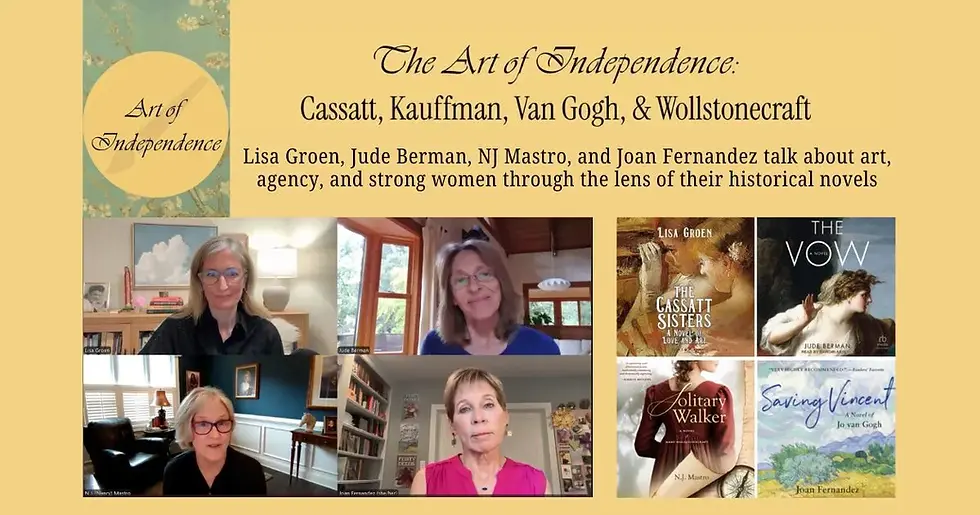
Then I remember people like Jo van Gogh, the star attraction in my based-on-true-story historical fiction, Saving Vincent.
A series of experiences allowed her to loosen and then set aside the late 19c assumptions she’d been taught about women from childhood and society. Work through her own intimidation and imposter syndrome. And ultimately choose to follow an inner conviction to not give up on her deceased brother-in-law, Vincent van Gogh, and his art.
The result was to save his artwork and so preserve his artwork for—holy moly— humanity.
She’s an example of a ripening and maturing away from limitations and so benefiting others.
I aspire to this too.
How’s your ripening going?


Comments